Before we jump into the “how-to” of rv fresh water tank sanitizing, let’s talk about why this isn’t just another chore to check off your list. It’s one of the most critical safety routines for any RVer. Regularly sanitizing your system gets rid of nasty bacteria, algae, and that slimy biofilm, making sure the water you drink, cook with, and shower in is safe and doesn’t have any weird tastes or smells.
Why Sanitizing Your RV Water System Is A Must-Do
Your RV’s fresh water tank is a closed environment. Let water sit in there, especially when it’s warm, and you’ve created the perfect breeding ground for all sorts of microscopic critters. This isn’t just a hypothetical problem; it’s a real-world risk every RVer faces.
The fallout from a contaminated system can range from simply annoying to downright dangerous. On the mild end, you might get a musty smell or a plasticky taste. On the severe end, you could be exposing your family to harmful bacteria that lead to gastrointestinal issues or worse.
The Telltale Signs You Can’t Ignore
You don’t need a science lab to tell you it’s time to sanitize. Your RV is pretty good at giving you clues. When you notice these signs, it’s time to take action.
Here are the most common triggers I’ve seen over the years:
- De-winterizing Your Rig: This is the big one. Your RV has been sitting idle for months. Any little bit of moisture left in the lines is a five-star resort for mold and bacteria. Sanitizing is non-negotiable when you’re opening up for the season.
- A “Funky” Smell or Taste: If your tap water smells like a swamp, rotten eggs, or tastes like plastic, that’s a direct signal of contamination or biofilm buildup. Don’t just live with it.
- Filling Up from a Sketchy Source: Ever hooked up to a well at a remote campground or a water spigot you weren’t sure about? You could be introducing new contaminants into your system. It’s always a good practice to sanitize after.
- Visible Slime or Algae: If you see a slimy film on your faucet screens (aerators) or inside the toilet bowl, that’s a dead giveaway that biofilm has taken over your plumbing.
Biofilm is a nasty, slimy layer that bacteria create to protect themselves. It clings to the inside of your tank and water lines like glue. Just flushing with water won’t cut it; you need a real sanitizing agent like bleach to break it down and get rid of it for good.
It’s More Than Just a Chore
If you start thinking of rv fresh water tank sanitizing as a key part of your maintenance routine instead of a dreaded task, the whole perspective changes. It’s a simple, proactive step that protects your health and makes your camping trips better. Nobody wants to be second-guessing their water quality when they’re supposed to be kicking back and enjoying nature.
When you understand what’s at stake—from stopping bad smells to keeping your family healthy—the process becomes an essential part of responsible RVing. Knowing that every drop from your faucet is clean and safe gives you priceless peace of mind on every trip you take.
Gathering the Right Supplies for the Job
A smooth RV fresh water tank sanitizing job starts long before you ever touch a drain valve. Having all your supplies gathered and ready beforehand saves you from that frustrating, last-minute run to the hardware store with your RV’s plumbing half-drained. Think of it as your pre-flight checklist; a little organization now prevents a lot of headaches later.
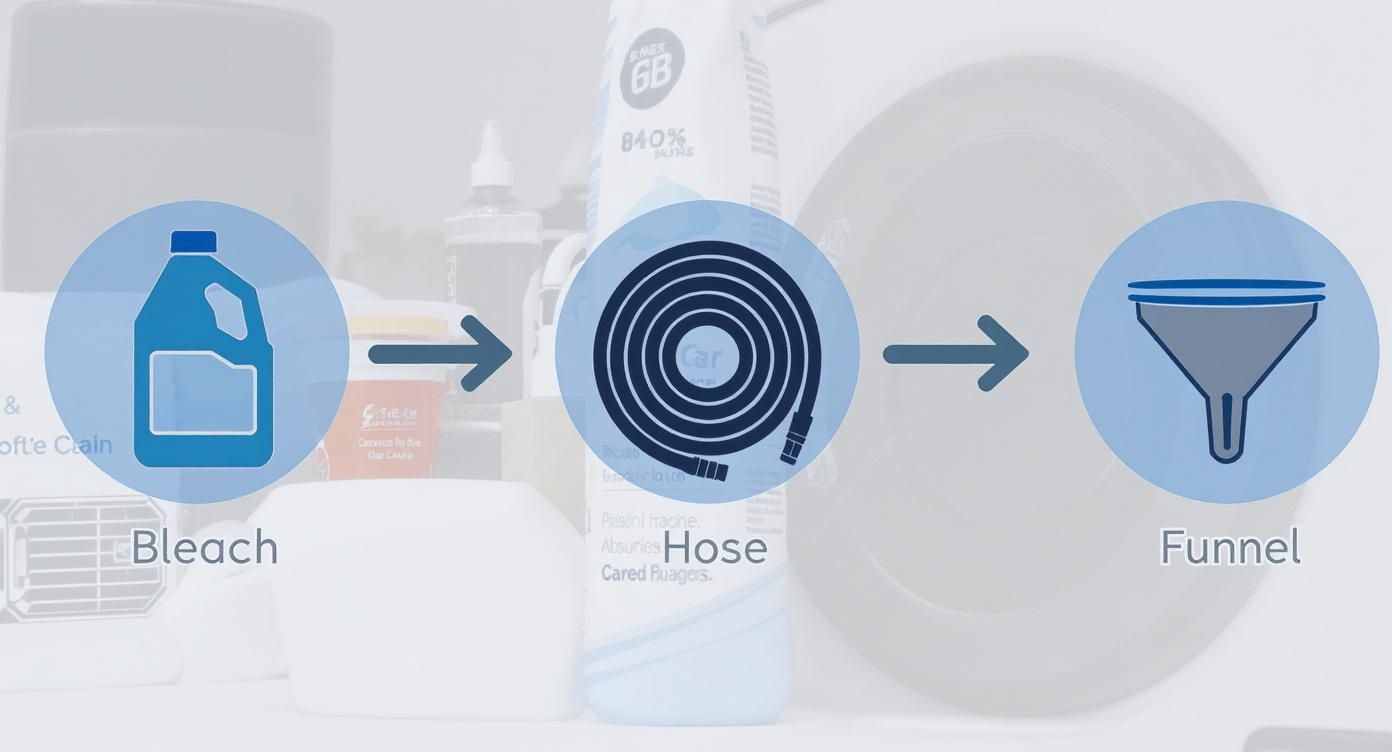
The main ingredient here is just plain old household bleach. But hold on—not just any bottle will do. You need to grab plain, unscented bleach that contains 5.25% to 8.25% sodium hypochlorite. Stay away from the “splash-less,” scented, or gel types. Their extra additives can leave behind nasty residues you definitely don’t want in your drinking water.
Essential Sanitizing Gear
Besides the right bleach, you’ll need a few other core items to get this done right. These are the absolute non-negotiables for a safe and effective sanitizing day.
- A Dedicated Potable Water Hose: This is a big one. Never use your black tank flush hose or a standard garden hose for this job. You need a separate, clean hose used only for fresh water to prevent cross-contamination. If you don’t already have one, grab a certified drinking-water hose from the potable water hose selection.
- Measuring Cups and a Funnel: Eyeballing the bleach-to-water ratio is a bad idea. Precision is key, so accurate measuring cups are a must. A funnel will also be your best friend, making it much easier to pour the diluted solution into your fresh water inlet without spilling it all over the side of your rig.
With these basics, you can absolutely get the job done. But if you want to make the process a whole lot smoother, a few extra tools can make a real difference.
Pro-Level Tools for an Easier Job
If you want to step up your maintenance game, think about adding a couple of specialized items to your toolkit. They aren’t strictly necessary, but they’re worth having.
A water pressure regulator is one of the best investments you can make for your RV’s entire plumbing system. You connect it between the spigot and your hose, and it protects your pipes and fittings from the dangerously high water pressure you can run into at some campgrounds. You’ll find a wide range of options by searching for RV water pressure regulators.
For a really deep clean, especially if you think some sediment has built up in your tank, a tank wand is invaluable. It’s a flexible, high-pressure nozzle that attaches to your hose, letting you spray down the inside walls of the fresh water tank to knock loose any stubborn gunk before you even start sanitizing. Look for versions marketed as RV fresh water tank wands.
Finally, just having a clean 5-gallon bucket on hand is always a good idea. You can use it to pre-mix your bleach solution before pouring it into the tank. This ensures it’s properly diluted and gets distributed evenly from the get-go. Getting prepped like this turns what could be a messy chore into a streamlined, efficient part of your regular RV maintenance.
The Complete Walkthrough for Sanitizing With Bleach
Alright, let’s get our hands dirty and walk through the entire process of sanitizing your RV’s fresh water system using good old household bleach. This is the practical, field-tested way to do the job right, covering the little details that actually make a difference between “mostly clean” and truly safe.
Think of this as your hands-on game plan, from start to finish.
Prep Work: Emptying the System
Before you even think about pouring anything, you need a completely empty system to work with. If your rig is just coming out of storage, chances are the tank is already drained. If not, your first stop is the fresh water tank drain valve, usually located underneath your RV. Open it up and let it go.
While that’s happening, head inside and open all your faucets—kitchen, bathroom sink, and both the indoor and outdoor showers. This lets air into the lines and helps push every last drop of water out.
This is also the perfect time to deal with your water heater. Crucially, make sure the heater is turned off and cooled down. Draining the system with the heating element on is a quick way to burn it out. Let the hot water side run for a bit, then open its drain plug or remove the anode rod to empty it completely. If your water heater has a bypass valve, now is the time to engage it to prevent the sanitizing solution from filling the heater tank.
Mixing and Adding the Bleach Solution
With an empty system, it’s time to do a little math. Getting the bleach-to-water ratio right is probably the single most important part of this whole job. Too little, and you won’t kill the nasty stuff. Too much, and you’ll be tasting chlorine for weeks, plus it can be hard on your plumbing seals over time.
The universally accepted guideline for sanitizing is about 1/4 cup (2 ounces) of plain household bleach for every 15 gallons of tank capacity. This is the concentration you need to effectively knock out bacteria, algae, and other microbes.
Here’s a quick cheat sheet to make things even easier.
Bleach Dilution Ratios for Common RV Tank Sizes
Use this quick-reference table to determine the correct amount of household bleach (5.25%-8.25% sodium hypochlorite) needed for your fresh water tank size.
| Tank Capacity (Gallons) | Bleach Amount (Cups) | Bleach Amount (Ounces) |
|---|---|---|
| 20 | 1/3 | 2.67 |
| 30 | 1/2 | 4 |
| 40 | 2/3 | 5.33 |
| 50 | 0.83 | 6.67 |
| 60 | 1 | 8 |
| 75 | 1 1/4 | 10 |
| 100 | 1 2/3 | 13.33 |
Note: These are approximations. Always double-check your tank’s specific capacity in your owner’s manual.
Once you’ve figured out the right amount, never pour concentrated bleach directly into your fresh water tank. Instead, dilute it first in a gallon or two of water. A clean 5-gallon bucket works perfectly for this. Give it a good stir, then use a funnel to pour the diluted solution into your RV’s fresh water fill port.
Getting the Solution Everywhere It Counts
After adding the bleach mixture, grab your dedicated drinking water hose and fill the fresh water tank completely. Keep an eye on your tank monitor panel to know when you’re full.
Now, the goal is to get that sanitizing solution into every single pipe, faucet, and fixture. Your RV’s water pump is about to do the heavy lifting.
Go inside and flip on the water pump. I always start with the faucet furthest from the pump, which is usually the kitchen sink or an outdoor shower. Open the cold water tap and let it run until you can smell bleach. It’s a very distinct smell, you won’t miss it. Once you’ve got it, shut it off and do the same thing for the hot water side.
Pro Tip: Don’t forget your showers and toilet! Run both the hot and cold lines in your indoor and outdoor showers until you get that bleach smell. Give the toilet a few flushes, too—that water line needs sanitizing just as much as the others.
Work your way through every fixture like this. This methodical approach ensures no part of your plumbing is left untreated. Once you’ve hit every tap, turn off the water pump.
The Waiting Game and the Final Flush
Here comes the easiest—but arguably most critical—part of the job: waiting. That bleach solution needs time to do its thing. Let it sit in the tank and plumbing for a minimum of 4 hours.
But if you really want to do a thorough job, let it sit for 8 to 12 hours (overnight is perfect). This longer “dwell time” gives the chlorine the chance to break down any stubborn biofilm and kill off anything that might be hiding in the system.
Once the time is up, it’s time to drain and flush. Open your low-point drains and the main fresh water tank drain again, and let the whole system empty out.
Close up the drains and refill the fresh water tank completely with clean, potable water. Turn the water pump back on and repeat the process from before, running fresh water through every single faucet (hot and cold), shower, and toilet until you can no longer smell any trace of chlorine.
Be prepared to drain and refill the tank two or even three times to get rid of the bleach smell completely. I know it feels a bit repetitive, but a thorough flush is the secret to having water that tastes fresh and clean on your next trip. After that final flush, you’re officially done. Your system is sanitized and ready for your next adventure
Creating Your RV Sanitizing Schedule
When it comes to RV fresh water tank sanitizing, one of the questions I get asked all the time is, “How often should I actually be doing this?” Honestly, there’s no single right answer. A one-size-fits-all approach just doesn’t work here because how you use your RV is what really dictates your maintenance routine.
The goal is to create a practical schedule that fits your travel habits, not some generic calendar. A full-timer who’s constantly cycling through their water supply has totally different needs than a weekend warrior whose rig sits in storage for weeks, or even months, at a time.
Tailoring a Schedule to Your RV Lifestyle
Let’s walk through a few common scenarios to help you figure out a schedule that makes sense for you. The biggest factor, by far, is how often you’re on the road.
- For the Weekend Warrior: If you’re mostly taking weekend trips with the occasional week-long vacation, sanitizing twice a year is a solid plan. I’d recommend doing the first one when you de-winterize in the spring. Then, do it again mid-season, maybe right before a big summer trip, just to keep everything fresh.
- For the Full-Time RVer: Living in your rig means your water system is always in use. While that constant flow helps prevent water from getting stagnant, the sheer volume of water passing through means more frequent cleaning is a good idea. For full-timers, I suggest sanitizing quarterly—about every three to four months—to stay on top of water quality.
Keeping your RV fresh water tank clean is all about preventing nasty stuff like mold, mildew, algae, and harmful bacteria from growing. For the average RVer, sanitizing at least twice a year is the recommendation, while those living in their RVs full-time should aim for three to four times a year. A proper sanitizing job can take half a day or more, but it’s crucial for avoiding waterborne illnesses and weird odors. You can find some more great insights on this over at the Escapees blog.
Remember, these are just starting points. The real key to a safe water system is knowing when to drop everything and sanitize immediately, no matter where you are in your schedule.
Critical Moments That Demand Immediate Sanitizing
Beyond your regular routine, some situations should be a red flag, signaling that it’s time for an immediate RV fresh water tank sanitizing. These are the non-negotiable moments where you just can’t afford to wait.
You should make sanitizing your top priority in these cases:
- After Buying a Used RV: You have absolutely no idea what the last owner’s habits were or what kind of water they put in the tank. Always, always start with a freshly sanitized system. It’s the only way to have complete peace of mind.
- When You Notice an ‘Off’ Smell or Taste: If your water starts smelling musty, like sulfur, or has a weird plastic taste, that’s a clear sign something is wrong. Don’t just flush the lines; do a full sanitization to kill whatever is causing the problem at its source.
- After Filling from an Unknown Water Source: That convenient spigot at a rustic campground might seem fine, but you really can’t be sure about the water quality. If you ever fill up from a source you don’t trust 100%, it’s smart to sanitize as soon as you can.
- Following a Long Period of Storage: Has your RV been sitting with water in the tank for more than a few weeks, especially in warm weather? It’s time to sanitize. Stagnant water is the perfect breeding ground for all sorts of nasty bacteria.
By combining a regular schedule based on your lifestyle with an eye for these critical moments, you shift from reacting to problems to actively preventing them. It’s the best way to ensure every drop of water from your tap is safe, clean, and tastes great.
Solving Common Sanitizing Problems
Even after following the steps for rv fresh water tank sanitizing perfectly, you can still run into a few hiccups. I’ve seen it all—a lingering swimming pool smell, a pump that just won’t cooperate, or a funny taste that refuses to leave. It’s frustrating, but the good news is that these are common issues with pretty straightforward fixes.
Don’t panic. Think of troubleshooting as the final, crucial step of the job. Getting these last details right is just as important as the initial sanitizing process.
The Lingering Chlorine Smell
One of the most frequent complaints I hear is a bleach smell that just won’t go away. If you’ve flushed your system multiple times and still smell chlorine, just running more water through probably won’t cut it. The chlorine has likely bonded to the plastic in your plumbing lines.
To get rid of it, a simple baking soda or vinegar solution works wonders.
- Mix one quart of white vinegar with five gallons of water and add it to your fresh water tank.
- Or, dissolve one cup of baking soda in one gallon of water, pour it into the tank, and then fill the rest of the tank with fresh water.
- Run your chosen solution through every faucet, just like you did with the bleach. Let it sit for a few hours, then drain and do one last fresh water flush.
This simple trick is way more effective than endlessly flushing with plain water. It actively neutralizes the chlorine, leaving your water tasting and smelling fresh again.
Help, My Water Pump Won’t Prime!
It’s an alarming moment: you’ve finished the job, but the water pump just whirs and whirs without building any pressure. This almost always means it has lost its prime, usually because air is trapped in the lines after you drained the system. It’s an easy fix, though.
First, make sure there’s plenty of water in your fresh tank. Then, open the faucet closest to the pump—that’s usually in the kitchen or bathroom. Turn the pump on and just let it run. Listen for the sound to change from a high-pitched whine to a lower, steadier hum. That’s the sound of the pump pushing the air out and finally grabbing water. It might take a minute or two.
When Bad Tastes and Odors Persist
What if you’ve sanitized, flushed, and neutralized, but the water still tastes musty or like plastic? This usually points to a stubborn biofilm colony that survived the first round of sanitizing. Biofilm can be incredibly resilient stuff.
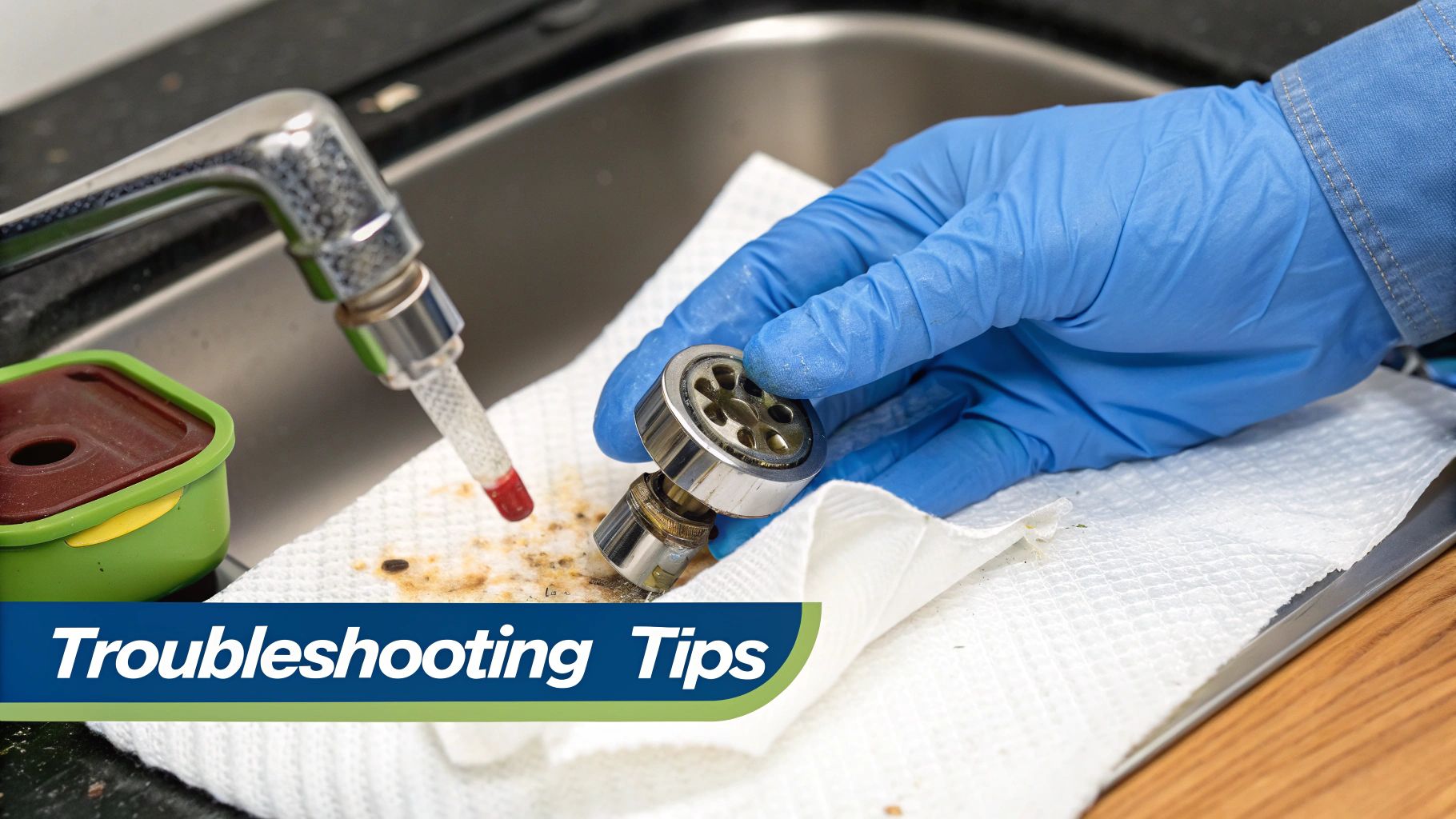
If this is your situation, you may need to repeat the process with a bit more muscle. Try a second sanitizing cycle, but this time, let the bleach solution sit for a full 12 hours to give it more time to work. It’s also a good idea to remove and clean individual parts like faucet aerators, which are notorious hiding spots for gunk.
Stubborn odors can also be a sign that water is sitting in your tank for too long between trips, especially in warmer weather. While sanitized water stays fresh for a while, stagnation is the enemy. Many RVers in this RV Network discussion have found that properly stored water can last for months, but ideal conditions are key. If your rig sits idle for long stretches, your best bet is to frequently flush and re-sanitize to keep things fresh.
Your Top Questions About Sanitizing Your RV, Answered
Even with the best step-by-step guide, there are always a few questions that come up when it’s time to sanitize your RV’s fresh water tank. Let’s dig into some of the most common ones I hear from fellow RVers. Getting these details right is what separates a decent job from a great one, giving you complete peace of mind about your water system.
Can I Use Something Other Than Bleach?
This is probably the number one question I get. While good old-fashioned bleach is still the most effective and widely recommended sanitizer out there, I get that some folks prefer to avoid it. The most common alternative people mention is vinegar.
Let’s be clear: vinegar is a fantastic cleaner. It’s great for breaking down mineral deposits and getting rid of that plasticky taste from a new tank. But it is not a sanitizer. It simply doesn’t have the muscle to kill the nasty bacteria, viruses, and mold that bleach knocks out. Think of vinegar as a pre-cleaner, not a replacement for a true sanitizing agent.
If you’re really set on avoiding bleach, you do have options. There are several commercially available RV drinking water sanitizers on the market. These products are specifically formulated to be effective and safe for your plumbing system. Just be sure to follow the manufacturer’s instructions to the letter, as they can vary. To see what’s available, search for RV drinking water sanitizers.
How Should I Dispose of the Bleach Water?
Proper disposal is a huge part of being a responsible RVer. You’ve got a tank full of chlorinated water, and you absolutely can’t just dump it anywhere. Dumping it on the ground can seriously harm plants, soil, and local wildlife.
The best-case scenario is to use a full-hookup campsite. You can run the bleach water through your faucets, letting it collect in your gray tank. Then, you simply empty the gray tank directly into the sewer connection where it will be properly treated. Easy and safe.
If you’re not at a full-hookup site, your next best bet is a designated RV dump station. You can drain the chlorinated water from your low-point valves into a portable waste tank or even a few large buckets and then dispose of it properly at the station.
A Quick Word of Caution: Never, ever drain bleach water into a storm drain. These often lead directly to local rivers and streams without any treatment, which can cause significant environmental damage.
Is It Safe to Be Inside the RV During Sanitizing?
Generally, yes, it’s safe to be in your RV while the bleach solution is working its magic in the tank and lines. But there are a few things to keep in mind. You are definitely going to notice a strong chlorine smell, which can be irritating for some people, especially anyone with asthma or other respiratory sensitivities.
The key is ventilation. I always recommend opening up the windows and roof vents to get a good cross-breeze going. You also won’t be able to use your water system for drinking, cooking, or showering during this time, so plan ahead. A lot of RVers I know start the process in the evening and let the solution sit overnight. By morning, you’re ready for the final flush.
I Accidentally Used Scented Bleach. What Do I Do?
It happens to the best of us. You grab the wrong bottle off the shelf, and now your water system has been sanitized with a scented or “splash-less” bleach. The main problem here is that these products contain additives, soaps, and fragrances that are a real pain to get out of your water lines. They can leave behind a soapy residue and an unpleasant taste that lingers.
The fix? A very, very thorough flushing process. You’ll need to drain and refill your tank with fresh water multiple times—probably more than the usual two or three flushes. Run fresh water through every single faucet, hot and cold, for several minutes each time you refill.
If the taste or smell persists after a few flushes, you can try the old baking soda trick. Mix a solution of about one cup of baking soda per gallon of water, run it through the system, and let it sit for a few hours. This can help absorb and neutralize some of those stubborn chemical tastes. It’ll take some extra work, but you can definitely get your system back to tasting fresh again.
For all the parts and accessories you need for your plumbing and fresh water system—from potable hoses and water filters to pumps and sanitizers—check out the selection at RVupgrades.com. Start by searching for fresh water system parts, or browse everything at RVupgrades.com.